In an increasingly digital tax environment, accurate invoice reporting and GST compliance have become more important than ever. One area that businesses need to pay close attention to is the validation of the “Ship-To GSTIN” while generating and reporting GST invoices.
The introduction of mandatory Ship-To GSTIN validation aims to improve the accuracy of transaction details, reduce incorrect GST reporting, and ensure that supplies involving multiple locations are properly recorded under the Goods and Services Tax (GST) framework.
In this blog, we explain what Ship-To GSTIN validation means, why it matters, and what businesses should do to ensure smooth GST compliance.
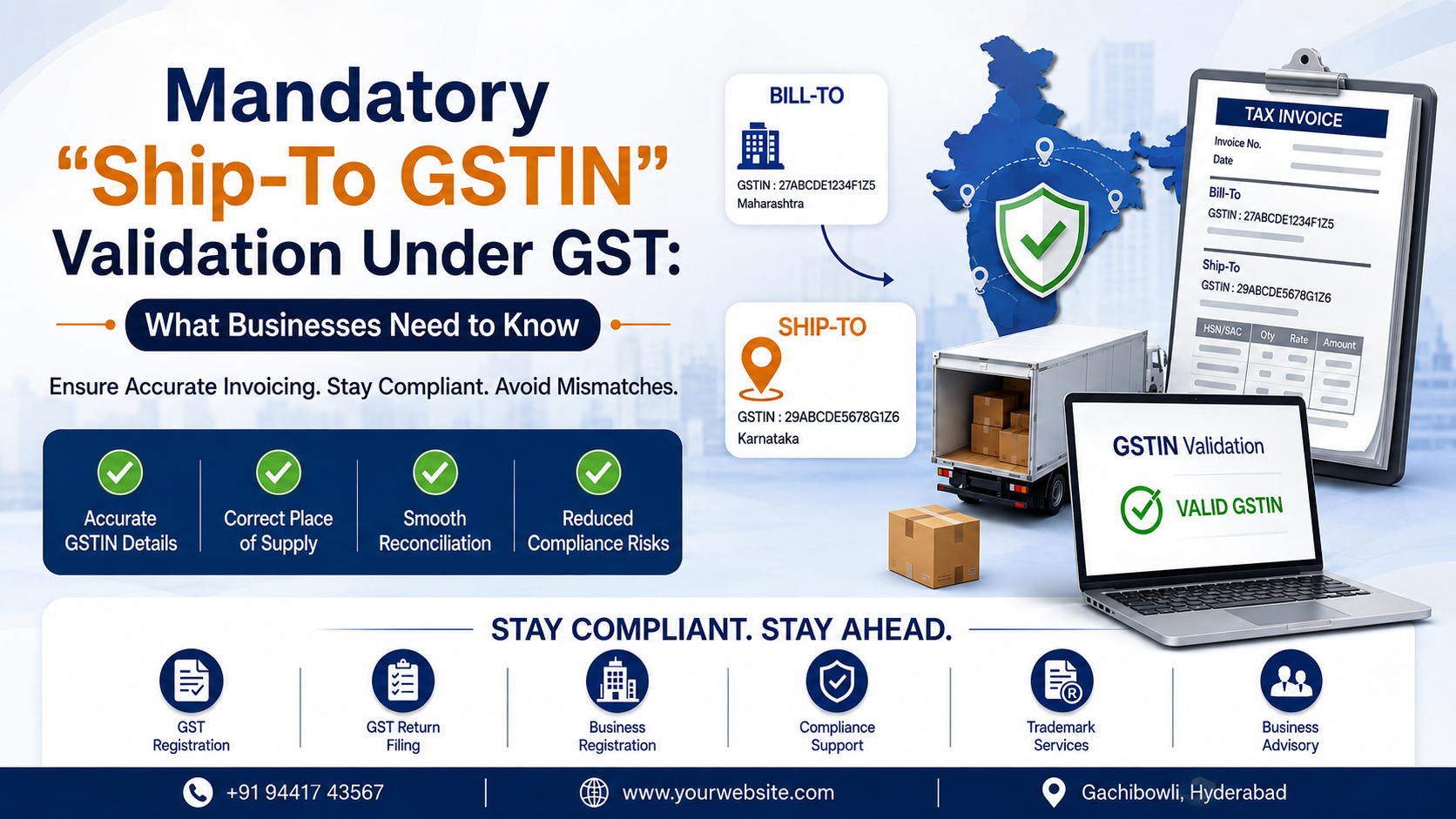
What Is a Ship-To GSTIN?
Under GST invoicing, there can be situations where the buyer (Bill-To party) and the recipient or delivery location (Ship-To party) are different.
The Ship-To GSTIN refers to the GST Identification Number associated with the location or registered person where goods are actually delivered, where applicable.
For example:
- A company places an order from its registered office in Hyderabad.
- The goods are delivered directly to its branch or another registered location in Bengaluru.
In such cases, the Bill-To and Ship-To details may differ, and accurate GSTIN reporting becomes essential for determining the nature of supply and maintaining proper transaction records.
What Does Mandatory Ship-To GSTIN Validation Mean?
Mandatory Ship-To GSTIN validation means that the GSTIN entered for the shipping recipient or location must be properly validated against the relevant GST registration details and invoicing requirements.
The objective is to ensure that:
- The GSTIN entered is valid and active.
- The recipient details are correctly reported.
- The State and GSTIN details are consistent.
- Incorrect or mismatched information is identified at the time of reporting.
- Businesses maintain accurate GST records and invoice data.
This validation can help reduce errors caused by incorrect GSTIN entries and improve the overall quality of information reported through the GST ecosystem.
Why Is Ship-To GSTIN Validation Important?
- Helps Ensure Accurate GST Compliance
Incorrect GSTIN details can lead to inconsistencies between invoices, e-way bills, GST returns, and other transaction records. Proper validation helps businesses maintain accurate compliance documentation.
- Reduces Invoice Errors
Manual data entry errors are common, especially for businesses handling a large number of invoices. Validating the Ship-To GSTIN can help identify incorrect or invalid details before they create compliance issues.
- Supports Correct Determination of Place of Supply
For transactions involving different locations, the place of supply and applicable tax treatment may depend on the nature and structure of the transaction. Accurate Bill-To and Ship-To information is therefore essential for proper GST reporting.
- Improves Reconciliation and Record Management
Consistent GSTIN information makes it easier for businesses to reconcile invoices, e-way bills, accounting records, and GST returns.
- Minimizes the Risk of Compliance Notices
Data mismatches can potentially attract queries or require businesses to provide additional explanations. Maintaining accurate transaction details can help reduce avoidable compliance risks.
Bill-To and Ship-To Transactions: A Simple Example
Let’s understand this with a practical example.
ABC Pvt. Ltd., registered in Maharashtra, places an order with a supplier in Gujarat. However, ABC instructs the supplier to deliver the goods directly to its registered branch in Karnataka.
In this situation:
- Bill-To Party: ABC Pvt. Ltd. – Maharashtra GSTIN
- Ship-To Location: ABC’s Karnataka location – relevant GST details, where applicable
- Supplier: Gujarat
Such transactions require careful consideration of the applicable GST provisions, invoicing requirements, and place-of-supply rules. Businesses should ensure that the details entered in their invoices and related compliance documents are accurate and consistent.
What Businesses Should Do to Prepare
Businesses should review their invoicing and GST compliance processes to ensure they are prepared for Ship-To GSTIN validation requirements.
✔ Verify GSTIN Details Before Invoice Generation
Ensure that the GSTIN provided by the customer or recipient is accurate and corresponds to the correct registered entity or location.
✔ Update Your Accounting and Billing Software
Businesses using ERP, accounting, or invoicing software should check whether their systems support accurate Bill-To and Ship-To details and appropriate GSTIN validation.
✔ Train Your Finance and Accounts Team
Employees responsible for invoicing should understand the difference between Bill-To and Ship-To transactions and the importance of entering GST details correctly.
✔ Maintain Proper Supporting Documentation
Purchase orders, delivery instructions, invoices, and transportation documents should be properly maintained to support the transaction structure.
✔ Reconcile GST Data Regularly
Regular reconciliation of sales invoices, e-way bills, and GST returns can help identify mismatches at an early stage.
Common Mistakes Businesses Should Avoid
Businesses should be particularly careful to avoid:
- Entering an incorrect or invalid Ship-To GSTIN.
- Using GST details belonging to the wrong State or entity.
- Assuming that Bill-To and Ship-To details are always interchangeable.
- Failing to update customer master data.
- Ignoring mismatches between invoices and transportation documents.
- Using outdated GST registration information.
A small data-entry mistake can create additional reconciliation work and compliance complications later.
How Aarthika Globcorp Can Help
GST compliance involves much more than simply filing monthly or quarterly returns. Businesses need proper guidance on invoicing, documentation, registrations, reconciliations, and ongoing statutory compliance.
Aarthika Globcorp provides professional support for businesses looking to manage their GST and compliance requirements efficiently.
Our services include:
- GST Registration
- GST Return Filing
- GST Compliance Support
- Business Registration
- Company & LLP Compliance
- Accounting and Tax Advisory
- Trademark & Intellectual Property Services
- Corporate Legal Documentation
Our team helps businesses understand their compliance responsibilities and maintain organized records for smoother operations.
Conclusion
The move towards mandatory Ship-To GSTIN validation reflects the growing importance of accurate and technology-driven GST compliance. Businesses should not wait until the last minute to review their invoicing systems and internal processes.
By validating GST details, maintaining accurate Bill-To and Ship-To information, and regularly reconciling transaction data, businesses can reduce errors and strengthen their overall compliance framework.
Accurate data is no longer just good accounting practice—it is an essential part of GST compliance.
If your business needs assistance with GST registration, GST return filing, invoicing compliance, or corporate compliance, professional guidance can help you stay organized, compliant, and focused on growth.
Frequently Asked Questions (FAQs)
- What is a Ship-To GSTIN?
A Ship-To GSTIN refers to the GST Identification Number associated with the recipient or registered location where goods are delivered, where applicable to the transaction. - Can the Bill-To and Ship-To locations be different under GST?
Yes. Certain business transactions involve different billing and delivery locations. The applicable GST treatment should be determined based on the facts of the transaction and relevant GST provisions. - Why is GSTIN validation important?
GSTIN validation helps reduce incorrect data entry, improve invoice accuracy, and minimize mismatches in GST-related records. - What should businesses do before issuing invoices?
Businesses should verify customer details, GSTIN information, billing and delivery locations, and ensure that their invoicing records are accurate. - Can professional assistance help with GST compliance?
Yes. GST professionals can help businesses understand invoicing requirements, maintain compliance records, file returns, and address transaction-specific GST issues.