
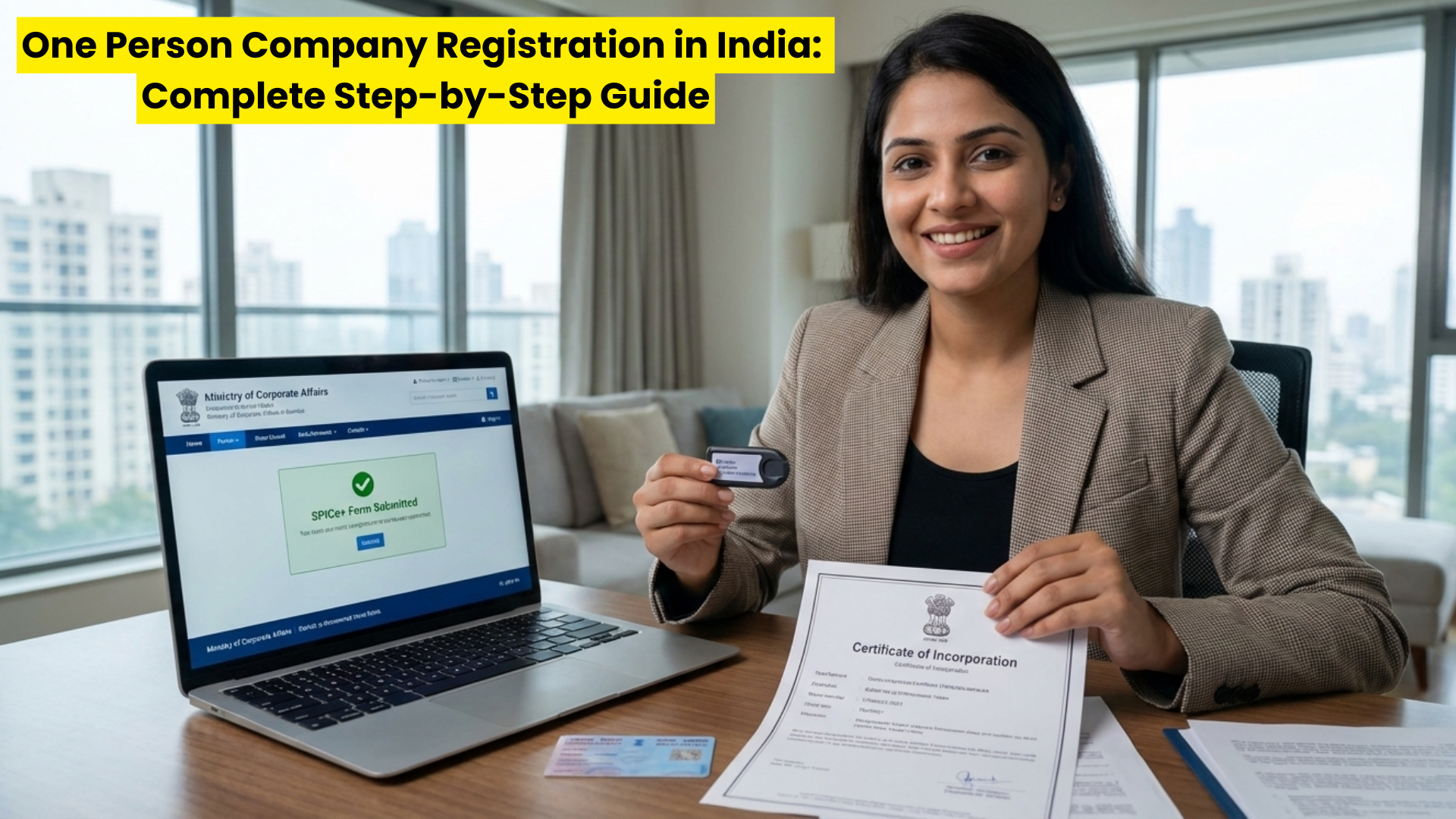
What is One Person Company? A One Person Company (OPC) is a special type of company in India made for solo entrepreneurs. As per the Companies Act, 2013, it is a company that has only one owner. This single person can act as both the shareholder and the director, which makes it easy to manage and control the business alone. The idea behind introducing OPCs was to support individuals who want to start their own business in a formal and legal way, especially small and micro businesses. With an OPC, a person doesn’t need partners or extra shareholders to register a company. An OPC gives the benefit of limited liability, meaning the owner’s personal assets are protected if the business faces losses. It also has perpetual succession, so the company continues to exist even if the owner changes. Overall, OPC is a simple and safe option for individuals who want to run a business professionally on their own. Characteristics of One Person Company To understand a One Person Company (OPC) more clearly, let’s look at its main features in simple words: Single Owner: An OPC has only one person as its owner. This person is both the shareholder and the director, but the OPC can have up to 15 directors. Nominee System: While registering the OPC, the owner must name a nominee. If something happens to the owner, the nominee will take over the company. This helps the business continue smoothly. Limited Liability: The owner’s personal property is protected. If the business faces losses or debts, only the company’s assets are at risk, not the individual’s personal assets. Separate Legal Identity: An OPC is treated as a separate legal entity. This means it can buy property, take loans, and sign contracts in its own name, separate from the owner. No Minimum Capital Requirement: There is no fixed minimum capital needed to start an OPC, which makes it easier for small entrepreneurs to begin their business. Perpetual Existence: The company continues to exist even if the owner changes or passes away, thanks to the nominee arrangement. Overall, an OPC is a simple and secure business structure for individuals who want to run a company on their own. Advantages Of OPC Easy to Raise Funds: Since an OPC is a registered company, it is easier to get funding from banks and financial institutions. Banks usually trust companies more than sole proprietorships while giving loans. Fewer Legal Compliances: OPCs enjoy several compliance relaxations under the Companies Act, 2013. They are not required to prepare a cash flow statement, and the books of accounts and annual returns can be signed only by the director, without a company secretary. Simple Incorporation Process: Starting an OPC is easy because only one member and one nominee are required. The owner can also be the director of the company. There is no minimum paid-up capital requirement, which makes incorporation simple and affordable. Easy to Manage: Since only one person owns and manages the company, decision-making is quick and smooth. There are no internal conflicts or delays, and resolutions can be easily passed and recorded by the sole member. Continues Forever (Perpetual Succession): Even though there is only one owner, the OPC does not stop existing. A nominee is appointed at the time of registration, and if something happens to the owner, the nominee takes over and runs the company. This makes OPC a convenient and secure business option for individual entrepreneurs. Disadvantages Of OPC Best for Small Businesses Only: An OPC is suitable mainly for small businesses. It can have only one owner at all times, so new members or shareholders cannot be added to raise extra capital. As the business grows, this structure may limit expansion. Restrictions on Business Activities: An OPC is not allowed to carry out Non-Banking Financial activities, such as investing in shares or securities of other companies. It also cannot be converted into a charitable company under Section 8 of the Companies Act, 2013. No Clear Separation Between Owner and Management: In an OPC, the owner is usually also the director. This means the same person owns and controls the business. Since all decisions are taken by one person, there is no separate management oversight, which may sometimes lead to misuse of power or unethical practices. These limitations should be considered before choosing an OPC as a business structure. Documents for OPC Registration For registering a One Person Company (OPC), some basic documents are required: Identity Proof: Any valid ID proof of the owner such as Aadhaar card, Passport, or Voter ID. Address Proof: Documents like electricity bill, water bill, or rent agreement to show the registered office address of the company. Landlord’s NOC: If the office premises are rented, a No Objection Certificate (NOC) from the landlord is required. Nominee’s Consent: A written consent from the nominee confirming that they agree to act as the nominee of the OPC. Digital Signature Certificate (DSC): This is needed to file company registration forms online. Director Identification Number (DIN): A DIN is compulsory for the director of the company. These documents help complete the OPC registration process smoothly. Registering an OPC The registration of a One Person Company (OPC) is done in a few simple steps: Get a Digital Signature Certificate (DSC): First, the owner needs to obtain a DSC. It is required to sign and submit forms online. Apply for Director Identification Number (DIN): The sole member must apply for a DIN through the Ministry of Corporate Affairs (MCA) website. This number is mandatory for anyone acting as a director. Reserve the Company Name: Choose a unique name for your OPC and apply for name approval through the MCA portal. Prepare Company Documents: Draft important documents like the Memorandum of Association (MOA) and Articles of Association (AOA), which define the company’s objectives and rules. Submit Incorporation Forms: File the required incorporation forms along with MOA, AOA, and other documents on the MCA portal. Receive Certificate of Incorporation: Once the documents

Financial Mistakes to Avoid in Your 20s & 30s
Your 20s and 30s are exciting years—you’re starting your career, earning your own money, and maybe even ticking off milestones like buying your first car or moving into your own place. But here’s the catch: these are also the years when financial mistakes can sneak in and haunt you for decades. Think about it—how often have you said, “I’ll start saving later” or “It’s just one swipe on the credit card”? Small decisions today can snowball into big consequences tomorrow. Let’s walk through the most common money mistakes young adults make, with real-life examples, and how you can dodge them. Not Making a Budget: One of the biggest mistakes young adults make in their 20s and 30s is living without a budget. Without tracking income and expenses, it’s easy to overspend on small luxuries like eating out, subscriptions, or impulse shopping, only to wonder where the money went at the end of the month. A budget is not about restricting yourself—it’s about giving your money direction. Following a simple framework like the 50-30-20 rule, where 50% of your income goes to needs, 30% to wants, and 20% to savings, can help you stay disciplined. Using apps or even a simple spreadsheet makes it easier to monitor spending patterns and adjust when necessary. Example: Riya, a 25-year-old engineer, spends freely on food delivery and weekend trips. By month-end, she’s broke despite a decent paycheck. Fix it: Use the 50-30-20 rule—50% for needs, 30% for wants, 20% for savings. Apps like Google Sheets or Mint make tracking painless. Ignoring Savings and Emergency Funds: Many young professionals focus on enjoying their earnings rather than saving, but life is unpredictable. An unexpected medical bill, job loss, or urgent expense can throw finances into chaos if there’s no backup. Building an emergency fund that covers three to six months of essential expenses provides a safety net during tough times. This fund should be kept in liquid assets like a savings account or liquid mutual fund so it’s easily accessible. Saving at least 10–20% of your monthly income consistently ensures you’re prepared for both planned goals and unforeseen emergencies. Example: Arjun had no emergency fund when his bike accident cost him ₹50,000. He had to borrow from friends. Fix it: Save 10–20% of your income and build an emergency fund covering 3–6 months of expenses. Keep it liquid (savings account or money market fund). Overusing Credit Cards: Credit cards are convenient, but they can quickly become a trap if misused. Paying only the minimum due each month leads to mounting interest charges, and before long, debt spirals out of control. Many young adults fall into this cycle by swiping freely for gadgets, trips, or lifestyle upgrades. The smarter approach is to use credit cards only when necessary and always pay the full balance on time. This not only avoids interest but also builds a healthy credit score, which is crucial for future loans like home or car financing. Example: Sneha bought the latest iPhone on her card but only paid the minimum due. Within a year, her debt ballooned to ₹1.5 lakh. Fix it: Swipe only when necessary and pay the full balance monthly. Bonus: you’ll build a strong credit score. Delaying Investments: A common mindset among young earners is to postpone investing until they “earn more.” Unfortunately, this delay costs them the most valuable resource—time. The earlier you start investing, even with small amounts, the more you benefit from compounding. For example, investing ₹5,000 per month at age 25 can grow into a massive corpus by retirement, while starting at 35 yields far less. Mutual funds, SIPs, and retirement accounts are excellent vehicles to begin with. The key is consistency—don’t wait for the “perfect time,” because the perfect time is now. Example: Rahul started investing ₹5,000/month at 25. By 55, he had nearly ₹1.5 crore. His friend Sameer started at 35 and ended up with just ₹50 lakh. Fix it: Start early—even small amounts matter. Explore SIPs, mutual funds, or retirement accounts. Compounding is your best friend. Not Setting Financial Goals: Without clear financial goals, money tends to get spent randomly. Goals give direction and purpose to your savings and investments. For instance, short-term goals might include buying a laptop or funding a vacation, medium-term goals could be saving for a car or house down payment, and long-term goals often involve retirement planning. Writing down these goals and aligning your spending habits with them ensures that your money is working toward something meaningful rather than disappearing into impulse purchases. Example: Priya spent impulsively on shopping and vacations. When she wanted to buy a car at 28, she realized she had no savings. Fix it: Set short-term (gadgets), medium-term (car, house), and long-term (retirement) goals. Align spending with these priorities. Ignoring Insurance: Many young adults assume insurance is only for older people, but this misconception can be costly. Health emergencies or accidents can wipe out savings in an instant. Buying health insurance early ensures affordable premiums and financial protection against medical expenses. Similarly, term life insurance provides security for dependents in case of unforeseen events. Insurance is not an unnecessary expense—it’s a shield that protects your financial stability and prevents setbacks from derailing your long-term plans. Example: Karan’s dengue hospitalization cost ₹80,000. Without health insurance, his savings took a hit. Fix it: Buy health and term life insurance early. Premiums are cheaper when you’re young, and coverage protects your family. Living Beyond Your Means: It’s tempting to upgrade your lifestyle as your income grows, but spending more than you can afford leads to financial stress. Lifestyle inflation—buying expensive gadgets, cars, or taking frequent trips on credit—creates debt that eats into future wealth. The key is to differentiate between needs and wants. Living within your means doesn’t mean denying yourself pleasures; it means balancing them responsibly. Avoiding peer pressure and focusing on your own financial goals helps you resist the urge to overspend. Example: A group of friends in their 20s took frequent international trips on
MSME Udyam Registration: Everything a Business Needs to Know
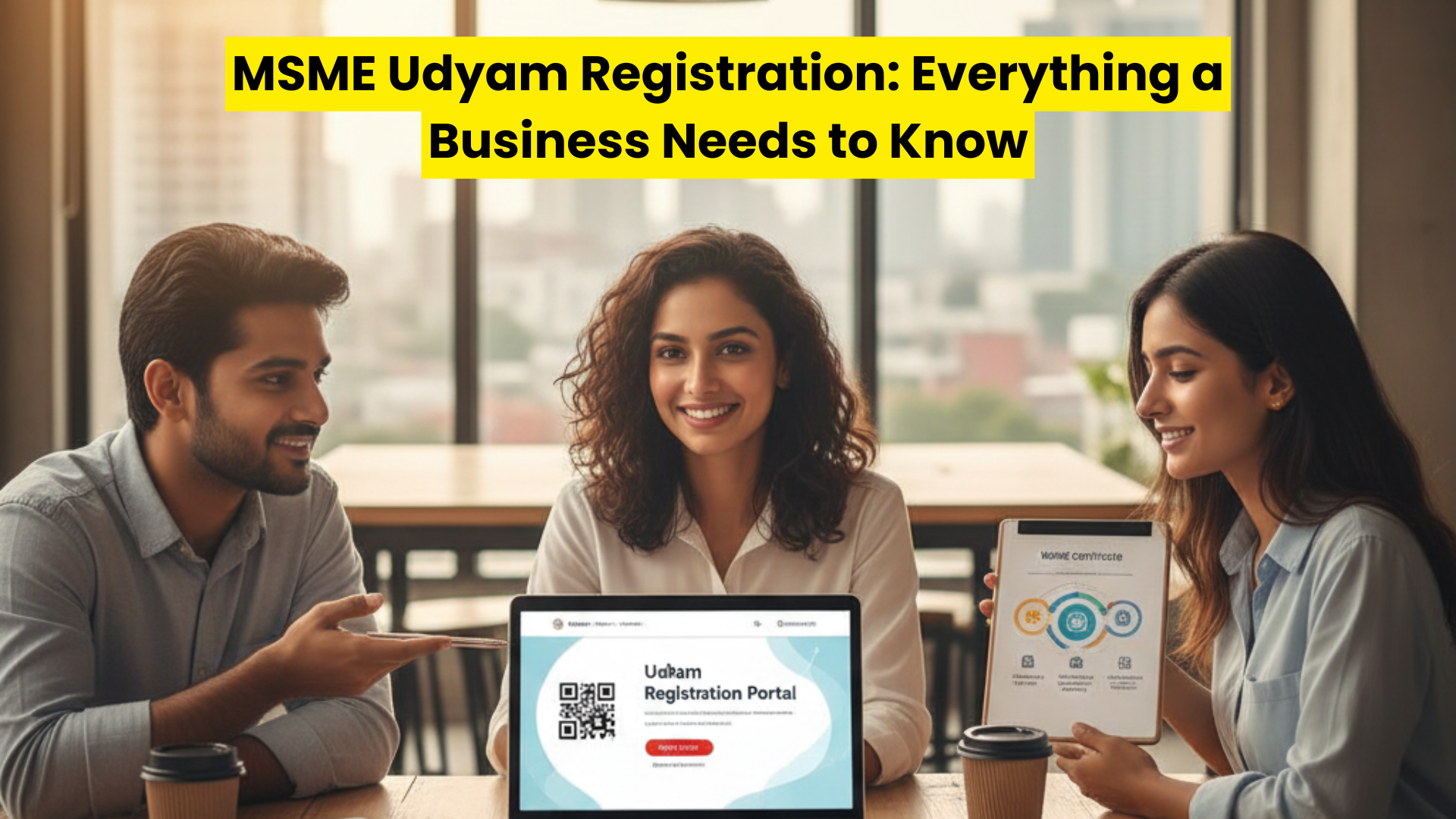
Every thriving company, regardless of size, starts with a vision — however, to convert that vision into sustained growth, it is essential to establish a solid groundwork. For countless Indian entrepreneurs, that cornerstone is the MSME Udyam Registration. Established by the Micro, Small and Medium Enterprises Development (MSMED) Act, 2006, this registration grants small and medium enterprises formal acknowledgment and a variety of government-supported advantages. It serves as more than just a compliance measure — it’s a vital resource for advancement, safeguarding, and trustworthiness. Comprehending MSMEs and Their Significance The benefits of acquiring MSME registration go well beyond basic acknowledgment. One of the greatest advantages is the simplicity of acquiring funding. MSMEs can access collateral-free loans through the Credit Guarantee Fund Trust for Micro and Small Enterprises (CGTMSE), preventing the absence of security from hindering business growth. Moreover, registered MSMEs benefit from reduced interest rates on loans, resulting in more affordable credit. Firms registered with Udyam are granted preference in government contracts and frequently do not have to provide Earnest Money Deposits (EMD). Additionally, MSMEs can receive subsidies for patent registrations and ISO certifications, and they may benefit from discounts on electricity bills and tax benefits based on state-specific regulations. A key feature of the MSMED Act is the safeguard against late payments. Purchasers engaging with MSMEs are required by law to settle payments within 45 days after delivery. In the event of a delay, they are required to pay interest at a rate that is three times the bank rate communicated by the Reserve Bank of India. This prevents small businesses from encountering liquidity challenges because of late payments, an issue. Traditional vs. Modern Understanding: The Development of MSME Categorization Prior to 2020, MSMEs were categorized distinctly for the manufacturing and service sectors depending entirely on their investment in machinery, equipment, or plant. Nonetheless, this previous definition was limiting and did not accurately represent the actual scope of contemporary enterprises. In order to promote development and remove uncertainty, the government amended the definition of MSMEs via a notification issued on 1st July 2020. The updated classification considers both expenditures on plant and machinery or equipment and yearly turnover, applying consistently across all sectors — both manufacturing and services. According to the new system, a Micro Enterprise is defined as one having an investment of up to ₹1 crore and a turnover that does not surpass ₹5 crore. A Small Enterprise may invest as much as ₹10 crore and generate a turnover of up to ₹50 crore, whereas a Medium Enterprise comprises firms with investments reaching ₹50 crore and turnovers not surpassing ₹250 crore. This updated definition enables companies to grow without the worry of forfeiting MSME status, thus promoting growth and competitiveness. Who is eligible to apply for MSME Udyam Registration? Registration for MSMEs is accessible to a diverse array of entities involved in manufacturing, production, processing, or delivering services. These consist of sole proprietorships, partnerships, Limited Liability Partnerships (LLPs), private and public limited companies, cooperative societies, trusts, as well as startups or freelancers working within the qualifying parameters. In essence, any enterprise that fulfills the investment and revenue requirements outlined in the MSMED Act is eligible to register under Udyam and be acknowledged as an MSME. How to Sign Up for Udyam – A Straightforward Online Procedure The process for Udyam registration is intended to be fast, clear, and entirely digital. Entrepreneurs can access the official site — https://udyamregistration.gov.in — and complete a self-declaration form with their Aadhaar and PAN information. The procedure does not need any physical paperwork or charges. Once essential business information like address, investment, and turnover is furnished, the registration can be submitted immediately. After completion, an Udyam Registration Certificate is generated online, serving as a permanent identifier for the business. The procedure is digital, automated, and effortless, guaranteeing that even small business owners with limited resources can effortlessly register and gain recognition. Advantages of MSME Udyam Registration The benefits of acquiring MSME registration go well beyond basic acknowledgment. One of the greatest advantages is the simplicity of acquiring funding. MSMEs can access collateral-free loans through the Credit Guarantee Fund Trust for Micro and Small Enterprises (CGTMSE), preventing the absence of security from hindering business growth. Moreover, registered MSMEs benefit from reduced interest rates on loans, resulting in more affordable credit. Firms registered with Udyam are granted preference in government contracts and frequently do not have to provide Earnest Money Deposits (EMD). Additionally, MSMEs can receive subsidies for patent registrations and ISO certifications, and they may benefit from discounts on electricity bills and tax benefits based on state-specific regulations. A key feature of the MSMED Act is the safeguard against late payments. Purchasers engaging with MSMEs are required by law to settle payments within 45 days after delivery. In the event of a delay, they are required to pay interest at a rate that is three times the bank rate communicated by the Reserve Bank of India. This prevents small businesses from encountering liquidity challenges because of late payments, an issue. Resolving Payment Disputes via MSME Samadhaan To enhance the protection of MSMEs, the government introduced the MSME Samadhaan Portal, a digital platform for addressing grievances. When buyers postpone payments, MSMEs can submit a complaint on this portal, which will be sent to the Micro and Small Enterprises Facilitation Council (MSEFC). The council is required to settle these disputes and guarantee payment — or payment with interest — within 90 days. This system enables small business owners to secure their owed payments without facing lengthy, costly legal processes. Reasons for All Businesses to Register as MSMEs Although your business may be small now, registering as an MSME can create numerous opportunities in the future. Udyam Registration increases your financial trustworthiness while also improving your business’s market standing. It establishes you as a legitimate entity recognized by the government, qualifying for various schemes, incentives, and protections. Regardless of whether you’re a startup entrepreneur, an expanding manufacturer, or a freelancer broadening your offerings, obtaining MSME
Latest GST updates on Input Tax Credit and Return Filing
If you own a business, work as an accountant, or are involved in finance, prepare yourself — India’s GST system is changing once more, centering on transparency, oversight, and more intelligent compliance. Beginning October 1, 2025, the GST Council has implemented a revised compliance framework that will transform how taxpayers handle Input Tax Credit (ITC), submit returns, and match invoices. These reforms are not small adjustments — they signify a significant advancement towards a completely data-driven GST framework, guaranteeing that every rupee of tax credit claimed is authentic, validated, and trackable. Throughout the years, officials have recognized various shortcomings in the GST system — including fraudulent invoices, discrepancies in ITC claims, and alterations of tax obligations. Although automation simplified the filing process, it also created opportunities for mistakes and improper use. The forthcoming adjustments seek to address those deficiencies by engaging taxpayers as active contributors in the credit validation and filing process instead of being mere recipients of data produced by the system. What is actually altering, and how will it influence your monthly compliance process? Let’s analyze it — and grasp how these changes could potentially simplify life for compliant taxpayers over time: • Discontinuation of Auto-Population for Input Tax Credit (ITC) The most significant change occurring this October is the end of automatic ITC population in GSTR-2B. Up to this point, taxpayers were able to see their eligible ITC directly in GSTR-2B according to the information submitted by suppliers in GSTR-1. Starting in October 2025, this convenience will be replaced by manual verification with the new Invoice Management System (IMS). Under the updated framework: All taxpayers are required to manually examine invoices submitted by vendors in the IMS portal. You must approve or deny each invoice in accordance with your actual purchase records. Only approved invoices will appear in your GSTR-2B, qualifying them for ITC claims in GSTR-3B. Any invoice that is unverified or rejected will not be included in the ITC calculation. This indicates that taxpayers need to take a more active part in cross-checking transactions prior to submitting their returns. • Tax Liability That Is Auto-Populated Becomes Non-Editable A significant change impacts the reporting of tax liability in GSTR-3B. Until now, taxpayers have had the ability to manually modify numbers in GSTR-3B, even when those figures were inconsistent with the auto-filled information from GSTR-1. This adaptability, while useful, frequently resulted in discrepancies, misunderstandings, and compliance challenges. With the new regulation, the auto-generated tax liability in GSTR-3B will be locked and non-editable. This is what it signifies for you: The tax owed detailed in GSTR-3B will be automatically connected with information from GSTR-1. These figures can no longer be edited or changed manually. All corrections or modifications should be done via GSTR-1 or GSTR-1A for the relevant tax period. This reform guarantees that your reported sales (in GSTR-1) and your tax payment (in GSTR-3B) stay completely synchronized. It lowers the chances of discrepancies and mistakes while fostering increased responsibility in data reporting. • Limitations on Credit Notes and ITC Reversal Adherence The third crucial reform concerns credit notes and reversals of ITC. Previously, suppliers were permitted to independently issue credit notes and modify their output tax liabilities. This sometimes caused discrepancies, particularly when recipients (purchasers) didn’t reverse the associated ITC. According to the new regulation, a supplier is not allowed to decrease tax liability via a credit note unless the recipient initially reverses the corresponding ITC in their return. Here’s the way the new procedure operates: When a vendor sends a credit note (for instance, because of a return of goods or a discount), the recipient has to initially negate the related ITC. The supplier’s tax liability will only be reduced after the buyer’s reversal. This establishes a mutual compliance connection between both parties, guaranteeing aligned reporting. This reform establishes a checks-and-balances system that guarantees the supplier and buyer keep precise and corresponding records. Although the new system might demand more involvement from taxpayers — checking invoices, assessing returns, and aligning data — it ultimately provides significant benefits. Companies that focus on compliance will gain increased credibility, more efficient audits, and reduced conflicts, fostering a culture of trust and responsibility between taxpayers and governing bodies. Essentially, these changes represent more than mere regulatory updates — they are integral to India’s larger shift towards smart taxation. For honest taxpayers, this presents a chance to enhance internal controls, utilize advanced digital tools, and accept a future where GST compliance is seen as a strength rather than a hassle. Register Now