
What is One Person Company?
A One Person Company (OPC) is a special type of company in India made for solo entrepreneurs. As per the Companies Act, 2013, it is a company that has only one owner. This single person can act as both the shareholder and the director, which makes it easy to manage and control the business alone.
The idea behind introducing OPCs was to support individuals who want to start their own business in a formal and legal way, especially small and micro businesses. With an OPC, a person doesn’t need partners or extra shareholders to register a company.
An OPC gives the benefit of limited liability, meaning the owner’s personal assets are protected if the business faces losses. It also has perpetual succession, so the company continues to exist even if the owner changes. Overall, OPC is a simple and safe option for individuals who want to run a business professionally on their own.
Characteristics of One Person Company
To understand a One Person Company (OPC) more clearly, let’s look at its main features in simple words:
- Single Owner: An OPC has only one person as its owner. This person is both the shareholder and the director, but the OPC can have up to 15 directors.
- Nominee System: While registering the OPC, the owner must name a nominee. If something happens to the owner, the nominee will take over the company. This helps the business continue smoothly.
- Limited Liability: The owner’s personal property is protected. If the business faces losses or debts, only the company’s assets are at risk, not the individual’s personal assets.
- Separate Legal Identity: An OPC is treated as a separate legal entity. This means it can buy property, take loans, and sign contracts in its own name, separate from the owner.
- No Minimum Capital Requirement: There is no fixed minimum capital needed to start an OPC, which makes it easier for small entrepreneurs to begin their business.
- Perpetual Existence: The company continues to exist even if the owner changes or passes away, thanks to the nominee arrangement.
Overall, an OPC is a simple and secure business structure for individuals who want to run a company on their own.
Advantages Of OPC
- Easy to Raise Funds: Since an OPC is a registered company, it is easier to get funding from banks and financial institutions. Banks usually trust companies more than sole proprietorships while giving loans.
- Fewer Legal Compliances: OPCs enjoy several compliance relaxations under the Companies Act, 2013. They are not required to prepare a cash flow statement, and the books of accounts and annual returns can be signed only by the director, without a company secretary.
- Simple Incorporation Process: Starting an OPC is easy because only one member and one nominee are required. The owner can also be the director of the company. There is no minimum paid-up capital requirement, which makes incorporation simple and affordable.
- Easy to Manage: Since only one person owns and manages the company, decision-making is quick and smooth. There are no internal conflicts or delays, and resolutions can be easily passed and recorded by the sole member.
- Continues Forever (Perpetual Succession): Even though there is only one owner, the OPC does not stop existing. A nominee is appointed at the time of registration, and if something happens to the owner, the nominee takes over and runs the company.
This makes OPC a convenient and secure business option for individual entrepreneurs.
Disadvantages Of OPC
- Best for Small Businesses Only: An OPC is suitable mainly for small businesses. It can have only one owner at all times, so new members or shareholders cannot be added to raise extra capital. As the business grows, this structure may limit expansion.
- Restrictions on Business Activities: An OPC is not allowed to carry out Non-Banking Financial activities, such as investing in shares or securities of other companies. It also cannot be converted into a charitable company under Section 8 of the Companies Act, 2013.
- No Clear Separation Between Owner and Management: In an OPC, the owner is usually also the director. This means the same person owns and controls the business. Since all decisions are taken by one person, there is no separate management oversight, which may sometimes lead to misuse of power or unethical practices.
These limitations should be considered before choosing an OPC as a business structure.
Documents for OPC Registration
For registering a One Person Company (OPC), some basic documents are required:
- Identity Proof: Any valid ID proof of the owner such as Aadhaar card, Passport, or Voter ID.
- Address Proof: Documents like electricity bill, water bill, or rent agreement to show the registered office address of the company.
- Landlord’s NOC: If the office premises are rented, a No Objection Certificate (NOC) from the landlord is required.
- Nominee’s Consent: A written consent from the nominee confirming that they agree to act as the nominee of the OPC.
- Digital Signature Certificate (DSC): This is needed to file company registration forms online.
- Director Identification Number (DIN): A DIN is compulsory for the director of the company.
These documents help complete the OPC registration process smoothly.
Registering an OPC
The registration of a One Person Company (OPC) is done in a few simple steps:
- Get a Digital Signature Certificate (DSC): First, the owner needs to obtain a DSC. It is required to sign and submit forms online.
- Apply for Director Identification Number (DIN): The sole member must apply for a DIN through the Ministry of Corporate Affairs (MCA) website. This number is mandatory for anyone acting as a director.
- Reserve the Company Name: Choose a unique name for your OPC and apply for name approval through the MCA portal.
- Prepare Company Documents: Draft important documents like the Memorandum of Association (MOA) and Articles of Association (AOA), which define the company’s objectives and rules.
- Submit Incorporation Forms: File the required incorporation forms along with MOA, AOA, and other documents on the MCA portal.
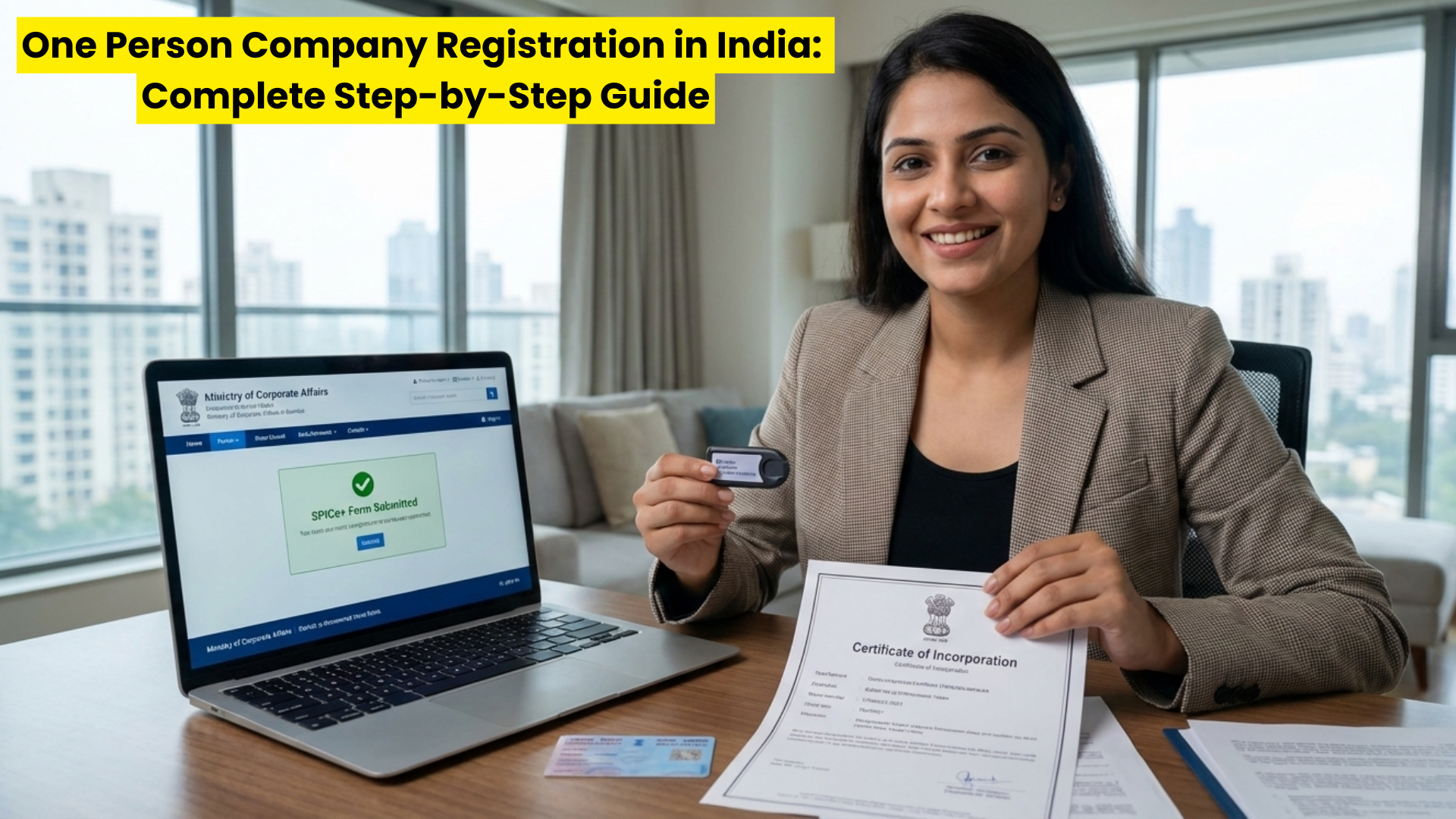
- Receive Certificate of Incorporation: Once the documents are verified and approved, the government issues a Certificate of Incorporation. This confirms that your OPC is officially registered.
After this, your One Person Company is legally ready to operate.